TANZANIA
|
Location:
|
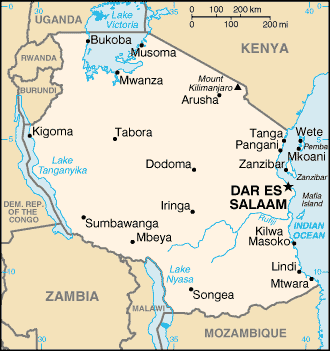
Eastern Africa, bordering the Indian Ocean, between Kenya and Mozambique |
|
Geographic coordinates:
|
6 00 S, 35 00 E |
|
Map references:
|
Africa |
|
Area:
|
total: 945,087 sq km land: 886,037 sq km water: 59,050 sq km note: includes the islands of Mafia, Pemba, and Zanzibar |
|
Area - comparative:
|
Slightly larger than twice the size of California |
|
Land boundaries:
|
total: 3,861 km border countries: Burundi 451 km, Democratic Republic of the Congo 459 km, Kenya 769 km, Malawi 475 km, Mozambique 756 km, Rwanda 217 km, Uganda 396 km, Zambia 338 km |
|
Coastline:
|
1,424 km |
|
Maritime claims:
|
territorial sea: 12 nm exclusive economic zone: 200 nm |
|
Climate:
|
varies from tropical along coast to temperate in highlands |
|
Terrain:
|
plains along coast; central plateau; highlands in north, south |
|
Elevation extremes:
|
lowest point: Indian
Ocean 0 m highest point: Kilimanjaro 5,895 m |
|
Natural resources:
|
Hydropower, tin, phosphates, iron ore, coal, diamonds, gemstones, gold, natural gas, nickel |
|
Land use:
|
arable land: 4.52% permanent crops: 1.08% other: 94.4% (2001) |
|
Irrigated land:
|
1,550 sq km (1998 est.) |
|
Natural hazards:
|
Flooding on the central plateau during the rainy season; drought |
|
Environment - current issues:
|
Soil degradation; deforestation; desertification; destruction of coral reefs threatens marine habitats; recent droughts affected marginal agriculture; wildlife threatened by illegal hunting and trade, especially for ivory |
|
Geography - note:
|
Kilimanjaro is highest point in Africa; bordered by three of the largest lakes on the continent: Lake Victoria (the world's second-largest freshwater lake) in the north, Lake Tanganyika (the world's second deepest) in the west, and Lake Nyasa in the southwest |
|
Population:
|
36,588,225 note: estimates for this country explicitly take into account the effects of excess mortality due to AIDS; this can result in lower life expectancy, higher infant mortality and death rates, lower population and growth rates, and changes in the distribution of population by age and sex than would otherwise be expected (July 2004 est.) |
|
Age structure:
|
0-14 years: 44.2%
(male 8,102,692; female 8,055,370) 15-64 years: 53.2% (male 9,646,342; female 9,834,925) 65 years and over: 2.6% (male 410,477; female 538,419) (2004 est.) |
|
Median age:
|
total: 17.6 years male: 17.3 years female: 17.8 years (2004 est.) |
|
Population growth rate:
|
1.95% (2004 est.) |
|
Birth rate:
|
39 births/1,000 population (2004 est.) |
|
Death rate:
|
17.45 deaths/1,000 population (2004 est.) |
|
Net migration rate:
|
-2.06 migrant(s)/1,000 population (2004 est.) |
|
Sex ratio:
|
at birth: 1.03 male(s)/female under 15 years: 1.01 male(s)/female 15-64 years: 0.98 male(s)/female 65 years and over: 0.76 male(s)/female total population: 0.99 male(s)/female (2004 est.) |
|
Infant mortality rate:
|
total: 102.13
deaths/1,000 live births male: 111.62 deaths/1,000 live births female: 92.35 deaths/1,000 live births (2004 est.) |
|
Life expectancy at birth:
|
total population:
44.39 years male: 43.2 years female: 45.61 years (2004 est.) |
|
Total fertility rate:
|
5.15 children born/woman (2004 est.) |
|
HIV/AIDS - adult prevalence rate:
|
8.8% (2003 est.) |
|
HIV/AIDS - people living with HIV/AIDS:
|
1.6 million (2003 est.) |
|
HIV/AIDS - deaths:
|
160,000 (2003 est.) |
|
Nationality:
|
noun: Tanzanian(s) adjective: Tanzanian |
|
Ethnic groups:
|
Mainland - native African 99% (of which 95% are Bantu consisting of more than 130 tribes), other 1% (consisting of Asian, European, and Arab); Zanzibar - Arab, native African, mixed Arab and native African |
|
Religions:
|
Mainland - Christian 30%, Muslim 35%, indigenous beliefs 35%; Zanzibar - more than 99% Muslim |
|
Languages:
|
Kiswahili or Swahili
(official), Kiunguju (name for Swahili in Zanzibar), English (official,
primary language of commerce, administration, and higher education),
Arabic (widely spoken in Zanzibar), many local languages note: Kiswahili (Swahili) is the mother tongue of the Bantu people living in Zanzibar and nearby coastal Tanzania; although Kiswahili is Bantu in structure and origin, its vocabulary draws on a variety of sources, including Arabic and English, and it has become the lingua franca of central and eastern Africa; the first language of most people is one of the local languages |
|
Literacy:
|
definition: age 15 and
over can read and write Kiswahili (Swahili), English, or Arabic total population: 78.2% male: 85.9% female: 70.7% (2003 est.) |
|
Telephones - main lines in use:
|
149,100 (2003) |
|
Telephones - mobile cellular:
|
891,200 (2003) |
|
Telephone system:
|
general assessment:
fair system operating below capacity and being modernized for better
service; VSAT (very small aperture terminal) system under construction domestic: trunk service provided by open-wire, microwave radio relay, tropospheric scatter, and fiber-optic cable; some links being made digital international: country code - 255; satellite earth stations - 2 Intelsat (1 Indian Ocean and 1 Atlantic Ocean) |
|
Radio broadcast stations:
|
AM 12, FM 11, shortwave 2 (1998) |
|
Television broadcast stations:
|
3 (1999) |
|
Internet country code:
|
.tz |
|
Internet hosts:
|
5,534 (2003) |
|
Internet users:
|
250,000 (2003 |
|
Railways:
|
total: 3,690 km narrow gauge: 969 km 1.067-m gauge; 2,721 km 1.000-m gauge (2003) |
|
Highways:
|
total: 88,200 km paved: 3,704 km unpaved: 84,496 km (1999 est.) |
|
Waterways:
|
Lake Tanganyika, Lake Victoria, and Lake Nyasa principal avenues of commerce with neighboring countries; rivers not navigable (2004) |
|
Pipelines:
|
gas 29 km; oil 866 km (2004) |
|
Ports and harbors:
|
Bukoba, Dar es Salaam, Kigoma, Kilwa Masoko, Lindi, Mtwara, Mwanza, Pangani, Tanga, Wete, Zanzibar |
|
Merchant marine:
|
total: 10 ships (1,000
GRT or over) 25,481 GRT/31,011 DWT by type: cargo 3, passenger/cargo 2, petroleum tanker 3, roll on/roll off 1, short-sea/passenger 1 registered in other countries: 5 (2003 est.) |
|
Airports:
|
123 (2003 est.) |
|
Airports - with paved runways:
|
total: 11 over 3,047 m: 2 2,438 to 3,047 m: 2 1,524 to 2,437 m: 5 914 to 1,523 m: 1 under 914 m: 1 (2004 est.) |
|
Airports - with unpaved runways:
|
total: 112 1,524 to 2,437 m: 19 914 to 1,523 m: 60 under 914 m: 33 (2004 est.) |