CHAD INFORMATION
| Introduction | Chad |
|
Background:
|
Chad, part of France's African holdings until 1960, endured three decades of ethnic warfare as well as invasions by Libya before a semblance of peace was finally restored in 1990. The government eventually suppressed or came to terms with most political-military groups, settled a territorial dispute with Libya on terms favorable to Chad, drafted a democratic constitution, and held multiparty presidential elections in 1996 and 1997. In 1998, a new rebellion broke out in northern Chad, which sporadically flares up despite two peace agreements signed in 2002 and 2003 between the government and the rebels. Despite movement toward democratic reform, power remains in the hands of a northern ethnic oligarchy. |
| Geography | Chad |
|
Location:
|
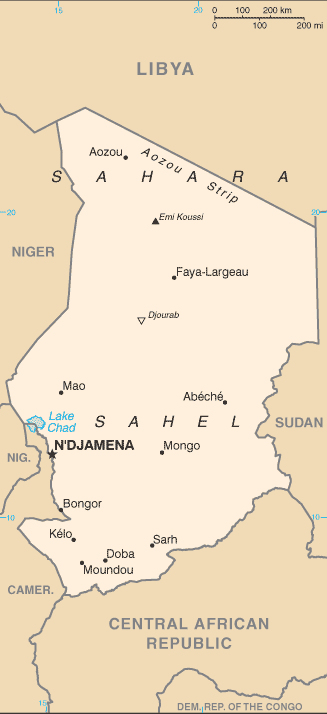
Central Africa, south of Libya |
|
Geographic coordinates:
|
15 00 N, 19 00 E |
|
Map references:
|
Africa |
|
Area:
|
total: 1.284 million sq km land: 1,259,200 sq km water: 24,800 sq km |
|
Area - comparative:
|
slightly more than three times the size of California |
|
Land boundaries:
|
total: 5,968 km border countries: Cameroon 1,094 km, Central African Republic 1,197 km, Libya 1,055 km, Niger 1,175 km, Nigeria 87 km, Sudan 1,360 km |
|
Coastline:
|
0 km (landlocked) |
|
Maritime claims:
|
none (landlocked) |
|
Climate:
|
tropical in south, desert in north |
|
Terrain:
|
broad, arid plains in center, desert in north, mountains in northwest, lowlands in south |
|
Elevation extremes:
|
lowest point: Djourab Depression 160 m highest point: Emi Koussi 3,415 m |
|
Natural resources:
|
petroleum, uranium, natron, kaolin, fish (Lake Chad) |
|
Land use:
|
arable land: 2.86% permanent crops: 0.02% other: 97.12% (2001) |
|
Irrigated land:
|
200 sq km (1998 est.) |
|
Natural hazards:
|
hot, dry, dusty harmattan winds occur in north; periodic droughts; locust plagues |
|
Environment - current issues:
|
inadequate supplies of potable water; improper waste disposal in rural areas contributes to soil and water pollution; desertification |
|
Environment - international agreements:
|
party to: Biodiversity, Climate Change, Desertification, Endangered Species, Ozone Layer Protection, Wetlands signed, but not ratified: Law of the Sea, Marine Dumping |
|
Geography - note:
|
landlocked; Lake Chad is the most significant water body in the Sahel |
| People | Chad |
|
Population:
|
9,538,544 (July 2004 est.) |
|
Age structure:
|
0-14 years: 47.9% (male 2,297,490; female 2,269,801) 15-64 years: 49.3% (male 2,245,586; female 2,459,796) 65 years and over: 2.8% (male 107,594; female 158,277) (2004 est.) |
|
Median age:
|
total: 16 years male: 15.3 years female: 16.7 years (2004 est.) |
|
Population growth rate:
|
3% (2004 est.) |
|
Birth rate:
|
46.5 births/1,000 population (2004 est.) |
|
Death rate:
|
16.38 deaths/1,000 population (2004 est.) |
|
Net migration rate:
|
-0.11 migrant(s)/1,000 population (2004 est.) |
|
Sex ratio:
|
at birth: 1.04 male(s)/female under 15 years: 1.01 male(s)/female 15-64 years: 0.91 male(s)/female 65 years and over: 0.68 male(s)/female total population: 0.95 male(s)/female (2004 est.) |
|
Infant mortality rate:
|
total: 94.78 deaths/1,000 live births male: 104.01 deaths/1,000 live births female: 85.17 deaths/1,000 live births (2004 est.) |
|
Life expectancy at birth:
|
total population: 48.24 years male: 46.91 years female: 49.63 years (2004 est.) |
|
Total fertility rate:
|
6.38 children born/woman (2004 est.) |
|
HIV/AIDS - adult prevalence rate:
|
4.8% (2003 est.) |
|
HIV/AIDS - people living with HIV/AIDS:
|
200,000 (2003 est.) |
|
HIV/AIDS - deaths:
|
18,000 (2003 est.) |
|
Nationality:
|
noun: Chadian(s) adjective: Chadian |
|
Ethnic groups:
|
200 distinct groups; in the north and center: Arabs, Gorane (Toubou, Daza, Kreda), Zaghawa, Kanembou, Ouaddai, Baguirmi, Hadjerai, Fulbe, Kotoko, Hausa, Boulala, and Maba, most of whom are Muslim; in the south: Sara (Ngambaye, Mbaye, Goulaye), Moundang, Moussei, Massa, most of whom are Christian or animist; about 1,000 French citizens live in Chad |
|
Religions:
|
Muslim 51%, Christian 35%, animist 7%, other 7% |
|
Languages:
|
French (official), Arabic (official), Sara (in south), more than 120 different languages and dialects |
|
Literacy:
|
definition: age 15 and over can read and write French or Arabic total population: 47.5% male: 56% female: 39.3% (2003 est.) |
| Communications | Chad |
|
Telephones - main lines in use:
|
11,800 (2002) |
|
Telephones - mobile cellular:
|
65,000 (2003) |
|
Telephone system:
|
general assessment: primitive system domestic: fair system of radiotelephone communication stations international: country code - 235; satellite earth station - 1 Intelsat (Atlantic Ocean) |
|
Radio broadcast stations:
|
AM 2, FM 4, shortwave 5 (2002) |
|
Television broadcast stations:
|
1 (2002) |
|
Internet country code:
|
.td |
|
Internet hosts:
|
8 (2004) |
|
Internet users:
|
15,000 (2002) |
| Transportation | Chad |
|
Highways:
|
total: 33,400 km paved: 267 km unpaved: 33,133 km (1999 est.) |
|
Waterways:
|
Chari and Legone rivers are navigable only in wet season (2002) |
|
Pipelines:
|
oil 205 km (2004) |
|
Ports and harbors:
|
none |
|
Airports:
|
50 (2003 est.) |
|
Airports - with paved runways:
|
total: 7 over 3,047 m: 2 2,438 to 3,047 m: 3 1,524 to 2,437 m: 1 under 914 m: 1 (2004 est.) |
|
Airports - with unpaved runways:
|
total: 44 1,524 to 2,437 m: 14 914 to 1,523 m: 20 under 914 m: 10 (2004 est.) |